
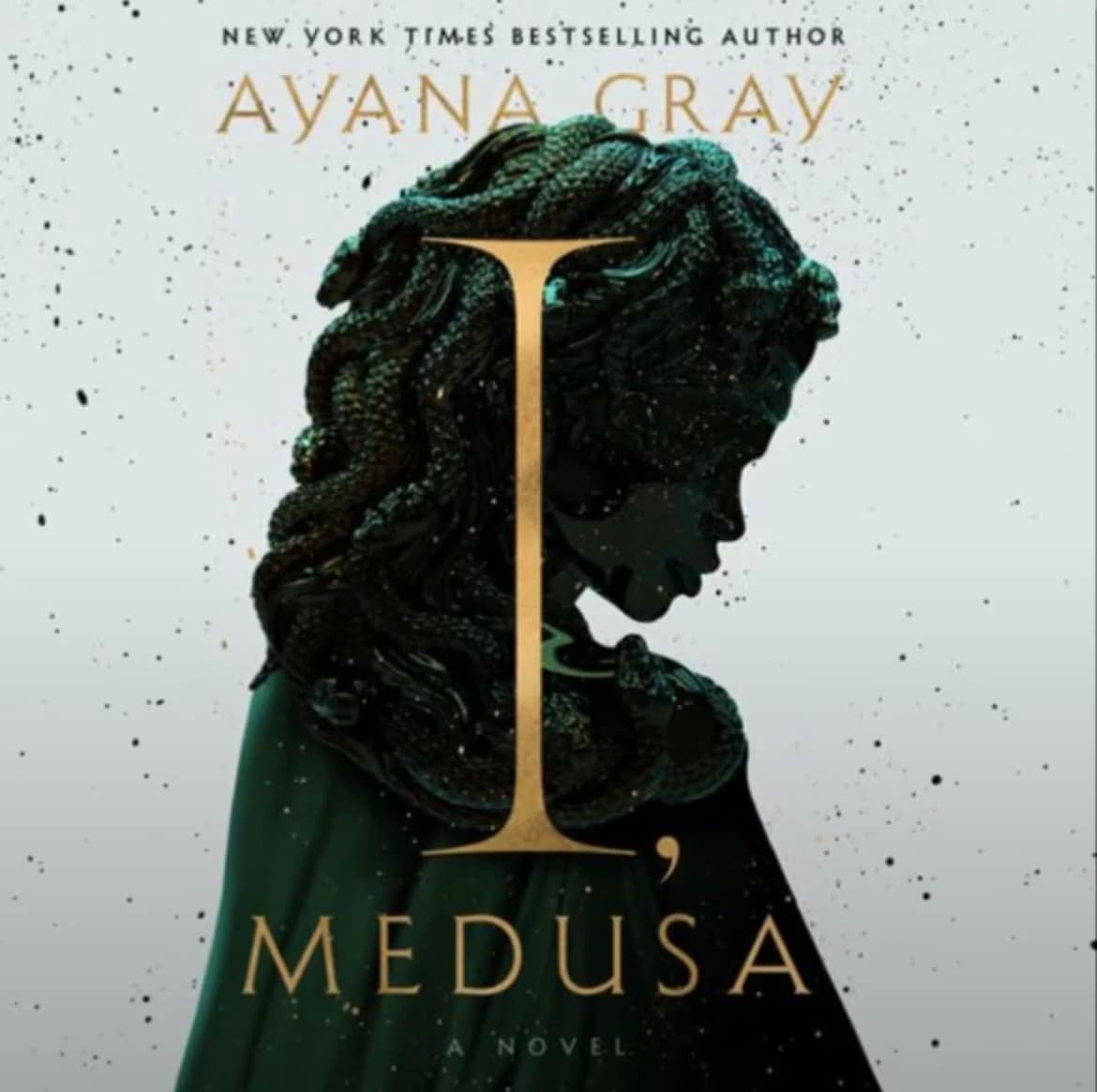
I have Medusa tattooed on my thigh, partly because of my love for mythology, but also because of her story. Her resilience and reclamation of her life and body have become pillars in how I move through the world. To me, her story signifies that you can still become strong despite what others have done to you. So when I, Medusa (get it for kindle here) started going viral in my book club, I had to pick it up.
The book follows Medusa in the final year of her life, reimagining her as being of African origin, a modern cultural trope that often equates her snakes with locs. It explores her turbulent life as a princess from a neglectful and abusive family, desperate to marry their daughters off to gain favor among the new gods. This added background helps humanize her, making her feel more like a young woman than the demon the original myths paint her as. I loved the depth of her backstory. It showed her as a person rather than a plot device. The strong connection between her and her sisters, and the tension between her parents, gave her emotional grounding. At times, I even found myself wishing Greek mythology gave her this much backstory.
The story then moves into how she is chosen by Persephone to become one of her priestesses after admitting she killed a demigod who tried to assault her. As she adapts to life in Athens, she faces bullying and racism within the temple while also forming meaningful alliances. While I appreciated the idea that her virtue and honesty were the reasons she was chosen, the bullying felt unnecessary. I understand it may have been included to emphasize her status as an outsider among the other women in Greece, but she didn’t need to be bullied or discriminated against to communicate that isolation.
My biggest issue is how the book romanticizes her relationship with Poseidon. It begins with subtle looks at a party her family is hosting. Then he follows her to Athens, disguising himself as a helpful young boy who repeatedly saves her from dangerous situations. The book builds sexual tension between them in his adult form, positioning it as a dramatic climax. But in the guise of a young boy, his behavior reads as grooming, trying to build trust and familiarity. I understand this may have been done to create narrative tension, but it felt deeply uncomfortable, especially considering that in the book, her father is an old sea god who would likely have known of Poseidon.
There is also a heavy emphasis on her virginity. What begins as a plot device slowly becomes unsettling, as characters repeatedly tie her purity to her youth. Despite being 18 and nearly married off, she is portrayed as so naïve that she does not even recognize sex when it is happening in front of her. That choice felt less symbolic and more infantilizing.
Eventually, after Medusa develops a crush on Poseidon (who is ultimately her predator ), he assaults her at a family gathering. Persephone discovers them, and what follows is a humiliating mockery of a trial. Zeus repeatedly asks her, “Well, did you say no?” while she stands half-nude, clothes torn, visibly confused. Persephone then curses Medusa, transforming her into the figure we recognize today.
From there, the story follows her escape to the mainland, her reconnection with an exiled former priestess, and her evolution into a vigilante figure who protects others from those who would prey upon them. She eventually returns home to discover her sisters were also transformed after standing up to the gods, and they live together on the island until her eventual demise.
Overall, the book offers an intriguing and beautifully written take on Medusa’s story. As a fan of Greek mythology, it was refreshing to see a character so often framed as a monster reimagined as a young girl who was victimized and fought to reclaim her power. It reignited my love for mythology and left me wanting to know more.
My only major critique is the romanticization of Medusa’s “relationship” with Poseidon and the framing of her life afterward. He assaulted her to hurt Persephone by taking something that belonged to her, and she ultimately punished the victim, presumably because of divine hierarchy. That dynamic deserved more clarity and less romantic tension.
I do wish the book had focused more on Medusa as a bright, ambitious girl with a future, rather than positioning her primarily as a savior figure. Still, the stakes were high, and I came away with a deeper understanding of who she was as a “person,” even within such a bold reimagining. (Grab the book here)
With love & moonlight,
Vintessa
Sacred musings | Mystic practices | Soft heart, wild spirit
Discover more from The Tranquil Vintessa
Subscribe to get the latest posts sent to your email.