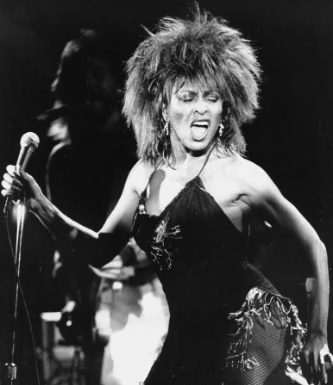
It was one of those strange warm autumn days, the kind that feels borrowed from another season. I had the windows cracked open, sunlight drifting across the floor, and Tina Turner’s “What’s Love Got to Do With It” humming through the room while I cleaned. And as it always does, the song pulled a memory from the back of my mind: bell hooks, and her declaration that love has everything to do with it. Except every time I hear Tina’s voice, I feel how deeply those two women were speaking about completely different worlds.
Tina wasn’t dismissing love. She wasn’t bitter, cold, or claiming it didn’t matter. She was saying something far more grounded and often more painful: love is not enough to make you stay somewhere that hurts. Love is not proof that a place is safe. Love alone isn’t a reason to abandon yourself.
bell hooks, on the other hand, wrote from the belief that love should sit at the center of everything—our choices, our healing, our ethics, our intentions. In her world, love is expansive and sacred, something we practice with devotion. But Tina was singing from the underside of love, the place where it bruises. hooks was writing from the ideal, the place where love becomes a practice of freedom. Neither woman was wrong, but hooks’ interpretation missed something essential in Tina’s message. She folded Tina’s truth into her own philosophy instead of hearing what Tina was actually saying: sometimes love exists, and it still isn’t enough.
I know that version of love too well. There were times I stayed because I thought love had to be enough—because someone gave me attention, gifts, or temporary affection, and I let myself believe those things held weight. I thought being chosen in pieces still meant being loved in whole. But love without care is confusion. Love without respect is chaos. Love without safety is surrender. None of that is enough to build a life on.
Eventually, I left situations everyone expected me to stay in. And I didn’t leave because someone stopped loving me; I left because I finally started loving myself, even in the darkness. That self-love didn’t arrive as confidence. It grew like a small flame in a place where no one taught me how to hold fire. It wasn’t pretty or polished, but it was mine—and it saved me.
So when I think about that moment—Tina singing about the limits of love, and hooks insisting love is the answer—I see it differently now. hooks teaches that love should guide us. Tina reminds us that love should not bind us. And somewhere between the two, I found my own truth: love matters deeply, but love is not everything. The love that truly has everything to do with my life is the love I refuse to abandon within myself.
That love is not fragile. It was forged in darkness, in clarity, in choosing myself when nothing else felt certain. It’s the one love that cannot be bought, broken, or taken. And maybe that’s what Tina was really pointing toward all along—not the dismissal of love, but the courage to say: if love costs me myself, it’s not love worth keeping.
.
With love & moonlight,
Vintessa
Sacred musings | Mystic practices | Soft heart, wild spirit